




















































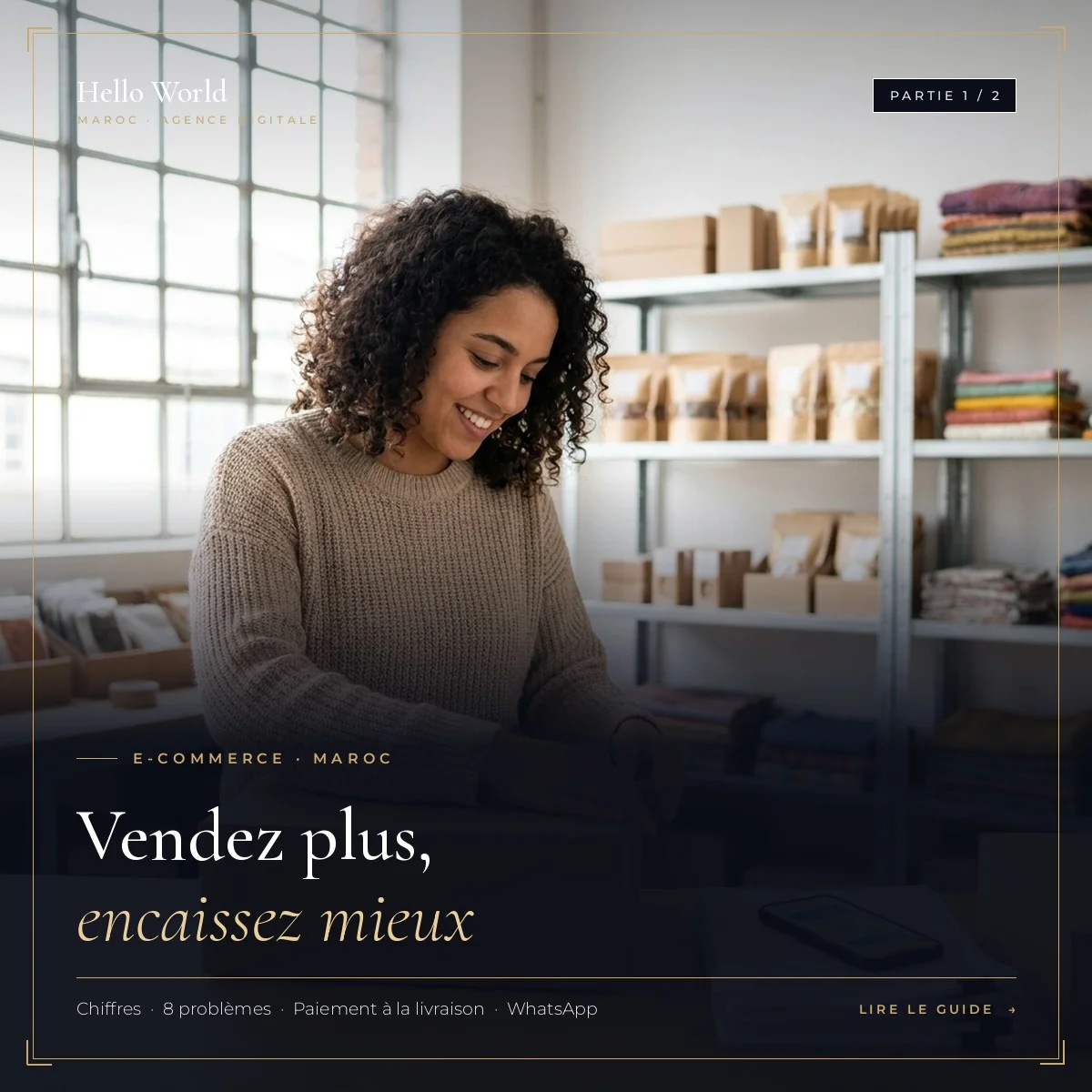
Tuesday, 6 pm, in a small warehouse in Casablanca. A young founder packs orders while her phone keeps buzzing: new Instagram orders, WhatsApp messages, a courier announcing three returns. Her ads are performing well. Yet at the end of the month, the cash collected does not match the figure shown in Facebook.
That is the whole job of an e-commerce digital marketing agency in Morocco: here, a sale is only real once it is delivered and paid for. The right indicator is not the number of orders, but the cost per delivered and paid order.
This two-part guide is for brands selling online, on Shopify, WooCommerce, Instagram or TikTok. Part 1 sets out the market figures, then details the 8 problems that cost Moroccan online stores money, with practical solutions.
E-commerce in Morocco in numbers
The potential is real. Almost the whole country is online, and card payments grow every year. But cash on delivery is still very common, and it sets the rules of the game.
On the advertising side, the platforms give an idea of the audience you can reach. Note that ad reach is not the number of active users: it is what the platforms' own tools report.
| Platform | Ad reach, end of 2025 |
|---|---|
| 22.8 million | |
| YouTube | 21.6 million |
| TikTok (18+) | 16.7 million |
| 15.1 million | |
| Snapchat | 7.64 million |
| LinkedIn (members) | 6.9 million |
Source: DataReportal, Digital 2026: Morocco.
The 8 biggest e-commerce problems in Morocco, and how to solve them
These are the problems we see in most Moroccan online stores, from young brands to established retailers. The table gives the overview; the details follow.
| Problem | Solution in one line |
|---|---|
| 1. Orders that never turn into cash | Manage by cost per delivered and paid order |
| 2. Rising cost per order | Refresh creatives and cut what does not deliver |
| 3. Order confirmation done by hand | Scripts and WhatsApp automation |
| 4. Product visuals that don't reassure | Real photos, demo videos, UGC |
| 5. A store that is slow on mobile | Light, clear, reassuring product pages |
| 6. Customers who buy only once | A repeat-purchase programme: WhatsApp, offers, bundles |
| 7. Ad tracking that can't see real sales | Link ads, orders and deliveries |
| 8. Ramadan, Eid and sales peaks | A calendar prepared weeks ahead |
Problem 1: orders that never turn into cash
An order placed is not a sale. Between the click and the money come confirmation, packing, delivery and collection. At each step, some orders are lost: wrong number, customer unreachable, parcel refused, return.
The solution: calculate the cost per delivered and paid order every week. Divide ad spend by the number of orders actually collected, not by the number of orders placed. This one figure often changes the whole strategy: a campaign that looked profitable can turn out to lose money, and the other way round.
| Stage | Indicator to track |
|---|---|
| Orders placed | Cost per order (as shown by the platforms) |
| Orders confirmed | Confirmation rate |
| Orders delivered | Delivery rate |
| Orders paid and kept | Return rate, then cost per delivered and paid order |
Problem 2: rising cost per order
An ad that works wears out quickly. After a few weeks, the same audience sees the same video, costs rise and sales fall. Many brands then raise the budget, which makes things worse.
The solution: produce new creatives every week, test several angles (the problem solved, the demonstration, a customer review, the offer) and cut quickly what does not deliver. Campaigns are judged on delivered orders, not clicks. Our lead generation Morocco service runs this testing rhythm on Meta and Google.
Problem 3: order confirmation done by hand
In many stores, one person spends the day calling customers to confirm orders. It is slow and costly, and customers called too late have often changed their minds.
The solution: an automatic WhatsApp message right after the order, with the summary, the total price, fees and delivery time, and a button to confirm. Doubtful cases are called back by a person with a short script in Darija and French. A WhatsApp chatbot Morocco can handle confirmation and frequent questions.
Problem 4: product visuals that don't reassure
A Moroccan customer paying on delivery is first buying a promise. Catalogue photos copied from a supplier do not make it believable. The result: more refusals at the door, because the product received does not look like the picture.
The solution: real product photos, short demo videos, customer content (UGC) and copy that answers doubts: size, material, use, delivery time. Good ad copywriting Morocco is the difference between an ad that attracts the curious and one that attracts buyers.
Problem 5: a store that is slow on mobile
Customers who arrive from Instagram, TikTok or Facebook are almost always on their phone. A heavy product page, with uncompressed images and pop-ups, drives them away before they even see the price.
The solution: fast, simple product pages, with price, reviews, guarantee, delivery and return terms visible without searching, and a short order form. Website creation Morocco designed for mobile costs less than months of advertising sent to a page that does not convert.
Problem 6: customers who buy only once
Paying to acquire a customer and never selling to them again means starting from zero every month. It is often the biggest source of lost margin.
The solution: a simple repeat-purchase programme. A WhatsApp message a few weeks after delivery, an offer on the second purchase, bundles (product plus refill, complementary products), and a list of customers who have agreed to receive messages. Customers who already paid on delivery and kept the product are the most reliable.
Problem 7: ad tracking that can't see real sales
Ad platforms see an order when the form is sent. They do not know whether the parcel was delivered, refused or returned. So they optimise towards people who order a lot, not necessarily those who pay.
The solution: connect the data. One shared table that follows each order from the ad to the cash, by campaign and by product. Where possible, send confirmed or delivered orders back to the platforms so they learn to find the right buyers.
Problem 8: Ramadan, Eid and sales peaks
The big moments of the year bring a large share of sales. Brands that prepare stock, offers and creatives the day before pay more for ads, deliver late and pile up returns.
The solution: a calendar prepared several weeks ahead, with stock checked, couriers warned, creatives ready and a stronger confirmation team. Details below in the Moroccan e-commerce calendar.
We start with an audit of your store, your ads and your confirmation process.
Cash on delivery: cutting refusals and returns
Cash on delivery reassures the customer but puts the risk on the seller. Every refused parcel costs the advertising, packing, outbound transport and often the return. A few simple rules make a big difference:
- Confirm fast: a message within minutes of the order, not the next day.
- Show the total price: product, delivery fee and delivery time, before confirmation.
- Check the address: city, district, landmark, reachable number.
- Warn before delivery: a message the day before or on the day.
- Analyse refusals: by city, product and ad. Some products or areas refuse more than others.
- Offer card payment: without forcing it, with a simple incentive (free delivery, a small gift).
Terms of sale, delivery times and the return policy must be displayed clearly, in line with Law 31-08 on consumer protection. Have your terms checked by a legal professional.
WhatsApp: confirm, follow up and retain
In Morocco, WhatsApp is the natural channel between a brand and its customers. Used well, it serves three moments:
| Moment | Typical message | Goal |
|---|---|---|
| Right after the order | Summary, total price, delivery time, confirm button | Confirm fast, avoid fake orders |
| Before delivery | Day and time slot of the courier | Reduce no-shows and refusals |
| After delivery | Usage tips, review request, repeat offer | Build loyalty and collect reviews |
Marketing messages require the customer's consent. Law 09-08 governs the collection and use of personal data (forms, CRM, WhatsApp), under the supervision of the CNDP: consent, declaration of processing, right to opt out. An order update and a promotional campaign do not follow the same rules.
The Moroccan e-commerce calendar
Planning the year avoids paying top price for ads at the last minute.
| Period | What sells | What to prepare |
|---|---|---|
| Ramadan | Home, kitchen, fashion, gifts, care | Stock, creatives, confirmation hours adapted to evenings |
| Eid al-Fitr and Eid al-Adha | Fashion, children, gifts, home | Clear delivery times, order deadline |
| Summer sales | Fashion, accessories, travel | Offers, bundles, returns management |
| Back to school | Supplies, children, tech | School bundles, ads aimed at parents |
| Black Friday and year end | Tech, beauty, fashion, gifts | Offers ready, stronger confirmation team |
Why choose an e-commerce digital marketing agency in Morocco
A general agency knows how to run ads. An e-commerce agency knows how to produce collected sales. The difference comes down to a few points:
- it manages by cost per delivered and paid order, not by the ROAS on screen;
- it connects advertising, store, confirmation and delivery;
- it produces creatives every week, not once a quarter;
- it knows the Moroccan reality: cash on delivery, Darija, cities, seasons.
Among the online brands supported by Hello World are Mabilévia, Yani Concept, Al Fahd Gallery, Resin World and Daba Pneu (see our case studies page). Part 2 covers our method, the channels, pricing and the questions to ask before choosing an agency.
Let's talk about your store: ads, confirmation, delivery and repeat purchases. (+212 6 75 47 20 01)