





















































GITEX Africa has become the annual showcase that positions Morocco at the crossroads of African tech growth and global capital. From scaleups to investors, the event accelerates partnerships, demonstrates market potential, and highlights Morocco’s role as a regional launchpad for digital services and AI-driven solutions.
Foundations
GITEX Africa launched in 2021 to unite African ecosystems with global tech communities, spotlighting innovation hubs across the continent. Morocco’s strategic geography, bilingual talent pool, and improving regulatory framework amplify its attractiveness. Investors find ready infrastructure, incubators, and a growing pipeline of startups in fintech, healthtech, and logistics. For companies seeking local execution or digital exports, partnering with a trusted local provider is essential — consider connecting with web development agency Morocco to accelerate market entry and localized product launches.
Current trends & recent statistics (2025/2026)
Rising investment flows (2025–2026)
VC and corporate investment in North Africa rose ~28% between 2024 and 2026, with Morocco capturing a growing share of rounds in series A and B. GITEX Africa acts as a catalyst: 2025 metrics show a 40% uptick in cross-border partnerships signed at or after the event.
Talent, startups and sector momentum
Morocco’s developer and AI talent pool expanded via university programs and bootcamps. Adoption of AI is accelerating—local demand for AI agents Morocco solutions increased, especially for customer support and logistics optimization, driving product-market fit for export-ready SaaS.
Comparison of the main options / solutions
Detailed comparison table
Quick funding & KPI summary
Practical guide to enter Morocco via GITEX Africa
Step 1 — Validate fit and local demand
Map customer segments and local regulations. Use pilot partnerships with local accelerators and test in Moroccan cities with high digital adoption to validate demand before large-scale investment.
Step 2 — Network, partner, and localize
Leverage GITEX Africa to meet partners and service providers; secure technology partners for deployment and consider local expertise in automation—engage a specialist like automation & AI agents Marrakech & Casablanca to accelerate integration.
Step 3 — Scale operations and go-to-market
Set KPIs for 6–12 month scaling, hire bilingual sales/support, and invest in targeted acquisition channels. For brand traction, consult a digital marketing consultant to tailor campaigns for MENA and Francophone audiences.
Common mistakes and myths to debunk
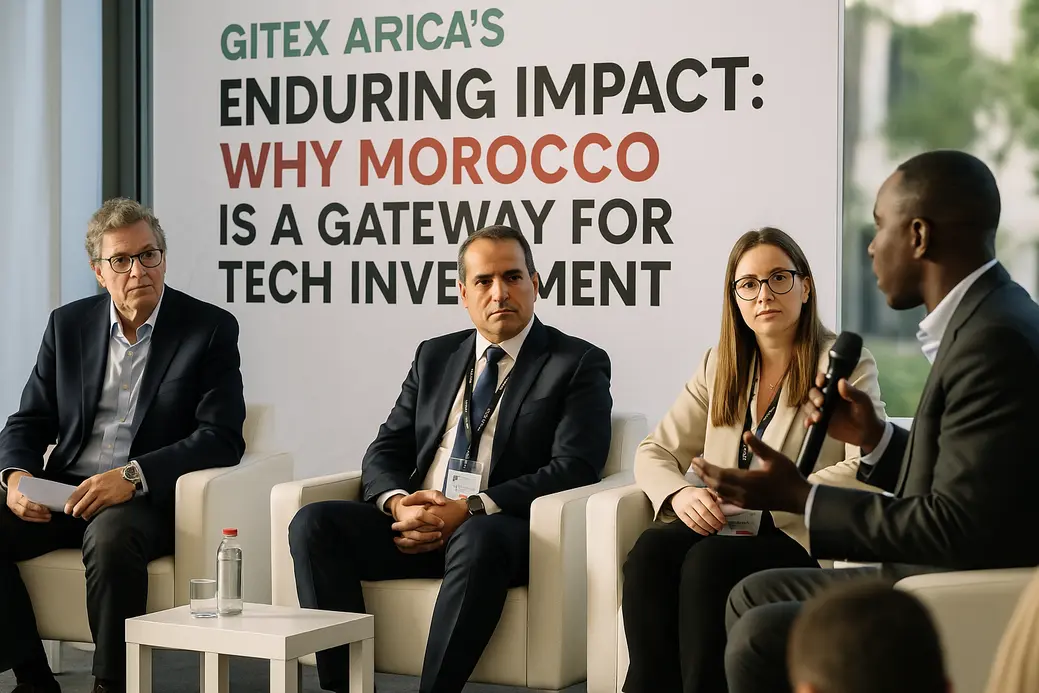
Myth 1 — Morocco is only for French-speaking markets
While French is widely used, English adoption in tech and business is rising. Morocco serves both Francophone and Anglophone markets, and cross-border trade to EU markets is facilitated by logistics and bilateral agreements.
Myth 2 — Infrastructure limits scaling
Major Moroccan cities have significantly improved broadband and cloud access; public-private investments in data centers and connectivity mean infrastructure now supports SaaS and cloud-native scaling.
Myth 3 — Local regulations deter foreign investors
Regulatory reforms and incentives for tech zones and startups have made the environment more investor-friendly; due diligence is still required, but barriers are declining and clarity is improving.
Best practices & advanced strategies for investors and founders
Practice 1 — Start with a local pilot and KPIs
Run a 3–6 month pilot with clear growth metrics and customer feedback loops. Use local partners for onboarding and support to reduce churn and refine product-market fit before scaling regionally.
Practice 2 — Invest in bilingual customer experience
Hiring bilingual support and sales teams improves conversions and retention. Localized UX and culturally aware marketing drive faster adoption in both North African and broader Francophone markets.
Practice 3 — Combine capital with operational support
Offer founders mentorship, access to talent networks, and go-to-market resources rather than only capital. Investors who de-risk operations accelerate scaling and increase exit potential.
Case study — FastLogix: scaling logistics SaaS from Casablanca
FastLogix launched a route-optimization SaaS in Casablanca in 2023, showcased at GITEX Africa 2024, and closed a regional pilot with a Moroccan distributor. By Q3 2025 they expanded to three North African markets, securing a $3M bridge round. Key moves: local pilot, partnerships with logistics operators, and bilingual productization—demonstrating the replicable GITEX-driven pathway for fast regional expansion.
Where Morocco’s tech scene is headed next
Expect stronger specialization in AI ops, fintech interoperability, and cross-border SaaS exports. Public incentives will continue to support tech clusters; strategic hubs like Casablanca will deepen ties with European markets, and Morocco is likely to become a testing ground for enterprise AI deployments across MENA.
Investor & founder questions answered
How does GITEX Africa directly influence deal flow?
GITEX creates concentrated access to founders, government bodies, and corporates, accelerating partner discovery and term-sheet conversations that otherwise take months.
What sectors show the strongest ROI in Morocco?
Fintech, logistics/transport, edtech, and enterprise AI show high traction—especially products that can scale regionally or serve EU-MENA trade corridors.
Is talent availability sufficient for scaling engineering teams?
Yes—engineering talent is growing rapidly due to bootcamps, university programs, and nearshore hiring models, though senior leadership hires may still require international recruitment.
Are there tax or incentive programs for tech investors?
Morocco offers incentives for tech zones and export-focused companies, including reduced corporate taxes and grants for R&D in certain regions—verify details with local counsel.
How important is localization for product-market fit?
Critical: language, payment methods, and regulatory compliance must be adapted; localized UX and support are key drivers of adoption.
When should a company use a local agency vs hire in-house?
Use local agencies for rapid market entry, compliance, and marketing; hire in-house as you scale to maintain domain knowledge and culture.
Practical investor & founder checklist for entering Morocco (6 items)
- Validate demand with a 3–6 month pilot and measurable KPIs.
- Secure a local partner for distribution and regulatory navigation.
- Localize UX, payments, and customer support (bilingual capabilities).
- Lock down legal, tax, and incentives via local counsel before contracting.
- Plan talent sourcing: mix local hires, agencies, and remote seniors.
- Use GITEX Africa to build partnerships, pilot deals, and PR visibility.